- About
-
Solutions
-
Services
-
Biosciences
- PureDisc™ Enabled Membrane Protein Production
- Assay Development and Transfer
- Biochemistry / Enzymology
- Biomarker Services
- Biophysics
- Cellular Biology
- Compound screening and cascade design
- Cryo-EM
- Fibrosis Assays
- Project Management and Consultancy Services
- Protein Expression
- Structural Biology
- X-ray Crystallography
- Chemistry
- Integrated Drug Discovery
- Computer Aided Drug Design
- Hit ID and Screening Services
- DMPK Services
-
Biosciences
- Target Classes and Modalities
- Therapeutic Areas
-
A-Z
- A
- B
- C
- D
- E
- F
- G
- H
- I
- K
- L
- M
- N
- O
- P
- R
- S
- T
- V
- X
-
Services
- Library
- News & Events
- Careers
- PureDisc™

Isothermal Titration Calorimetry (ITC)
Label-free biophysical analysis of biomolecular interactions
Isothermal Titration Calorimetry (ITC) is a biophysical technique which directly measures the heat released or absorbed during molecular binding events in a label-free environment. It is typically used to study the binding of small molecules to larger macromolecules such as proteins or DNA.
During ITC, the small molecule is titrated into the larger macromolecule and if binding occurs, heat is given off (or absorbed) with each injection, until the protein is saturated. The dissociation constant (Kd), molar free energy change (ΔG), observed molar enthalpy change (ΔHobs), observed molar entropy change (ΔSobs) and the stoichiometry (n) of the binding interaction can be determined, providing a complete thermodynamic profile. This information can be used to differentiate between binding events that are driven by enthalpy or entropy.
Advantages of Isothermal Titration Calorimetry
- Complete thermodynamic profiling in a single experiment
- No labelling or immobilization required
- Non-destructive technique
- Solution-based technique
- Experiments can be performed using a broad range of solvents and buffers
- Rapid results
- Suitable for the assessment of a wide range of binding affinities and molecules with a wide range of molecular weights
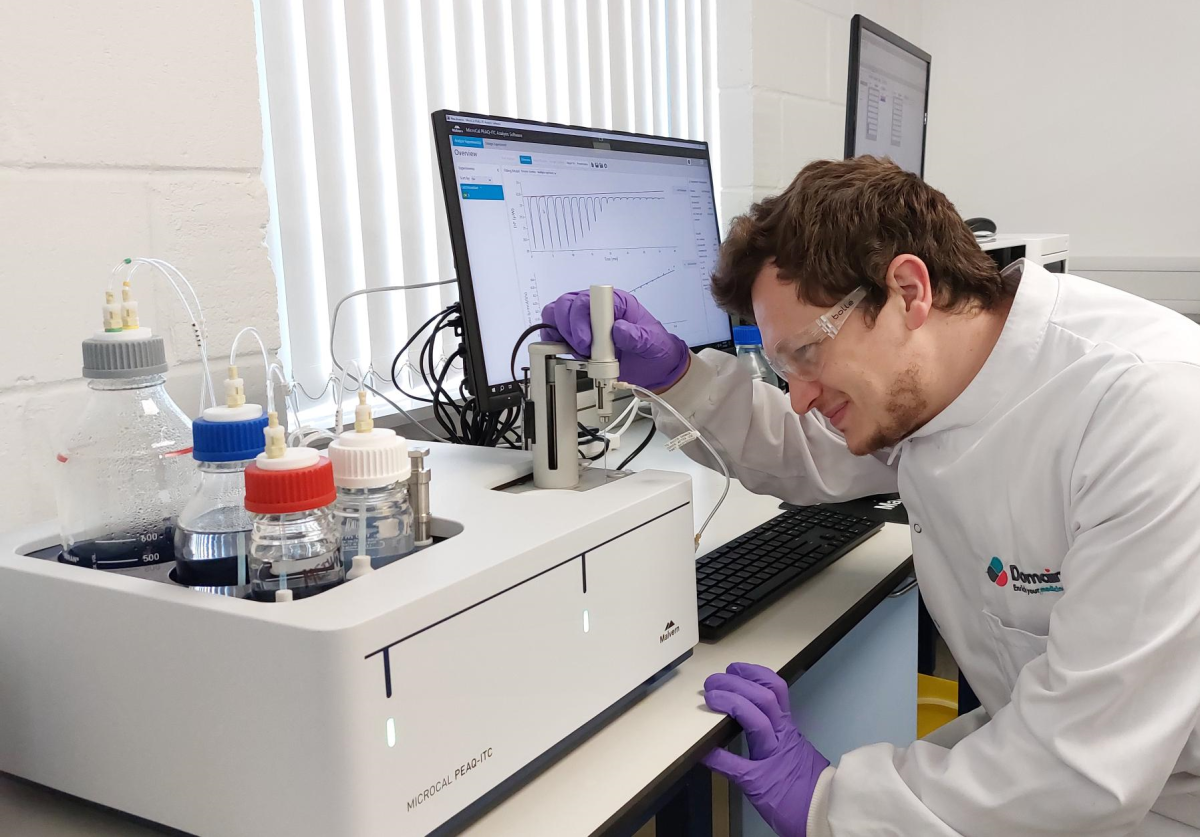
Domainex has a highly experienced team of biophysicists and has invested in a Malvern Panalytical PEAQ-ITC instrument with MicroCal technology. The PEAQ-ITC is a highly sensitive instrument which requires only low sample volumes to determine affinity, stoichiometry and thermodynamic parameters for molecular interactions.
Please contact us if you would like to find out more about our ITC services or any of our other biophysical techniques.
Frequently Asked Questions
How does ITC work?
ITC is a biophysical assay which measures the change in heat (ΔG) when 2 molecules interact. This heat change can be caused by the making (exothermic) or breaking (endothermic) of non-covalent bonds. The ITC instrument has two cells, one is the reference cell and the other is the sample cell. Within the injection syringe, there is a ligand which is titrated into the sample cell at a rate of 0.5 uL-2uL volumes until the ligand concentration reaches 2-3x that of the sample in the cell. There are devices which are sensitive to heat which are used to monitor the temperature difference between the reference and sample cell as the titration is occurring.
What types of molecular interactions can Domainex test with ITC?
Domainex's ITC facilities are suitable for studying the binding of small molecules to macromolecules, including proteins and DNA, and supports applications requiring full thermodynamic characterisation across diverse molecules.
What information does ITC provide about binding interactions?
From a single ITC experiment it is possible to determine the Dissociation constant (Kd), Free energy change (ΔG), Enthalpy and Entropy change (Δhobs and (ΔSobs), as well as the Stoichiometry (n) of a molecular interaction. By combining all of these parameters together, a complete thermodynamic profile of the interaction can be generated and used to categorise the interaction as either entropically or enthalpically driven.
What are the protein requirements for this assay?
ITC often has a large protein requirement both in volume and concentration.
Volume per run: > 300 uL of protein for the sample cell and 100-120 uL of ligand for the syringe
Protein concentration per run: for the sample cell is at least 10x Kd, whilst the concentration of ligand in the syringe is more than 10x the concentration of protein used within the cell
How many ITC experiments will be required?
Typically, Domainex runs more than 1 ITC experiment. The initial experiment often acts as a starting point for further optimisations to either the concentration of either sample or ligand; injection volume and frequency; and stirring speed.
What are the required control experiments?
To ensure data reliability, Domainex carries out at least two control experiments:
- Buffer in the syringe injected into buffer in the cell. This control titration identifies buffer mismatch
- Buffer in the syringe injected into sample in the cell
- Ligand in the syringe injected into buffer in the cell
Are ITC assays affected by the presence of DMSO?
ITC assays have the potential to be affected by the presence of DMSO particularly if there is a mismatch between buffer in the syringe and buffer in the cell. This is due to the DMSO mismatch causing a large signal which has the potential to cover any true binding signal rendering the data difficult to deconvolute. If there is no buffer mismatch then this is not an issue. However, ensure that DMSO concentrations are kept below 10%.
Which buffers are compatible with ITC?
Ideally use a buffer which keeps your protein soluble. If the buffer has been used in other kinds of binding assays successfully, chance is it will be suitable for use in ITC too. However, note that glycerol concentration must be kept below 20% to reduce bubble formation in either the cell or syringe. If the buffer contains a surfactant, please ensure the concentration is kept below the CMC (critical micelle concentration). Reducing agents such as TCEP or 2-mercaptoethanol are recommended.
My protein is prone to aggregation - will this affect the results an ITC experiment?
Yes, aggregation will affect and interfere with ITC. Please make sure that if possible proteins have been purified using size-exclusion chromatography and that the sample is homogenous.
What are the advantages of ITC over other biophysical assays?
- Complete thermodynamic profiling in one experiment
- No labelling or immobilisation required
- Non destructive, solution based method
- Compatibility with a broad range of solvents and buffers
- Rapid results Suitable across a wide range of molecular weights and affinities
Start your next project with Domainex
Contact one of our experts today